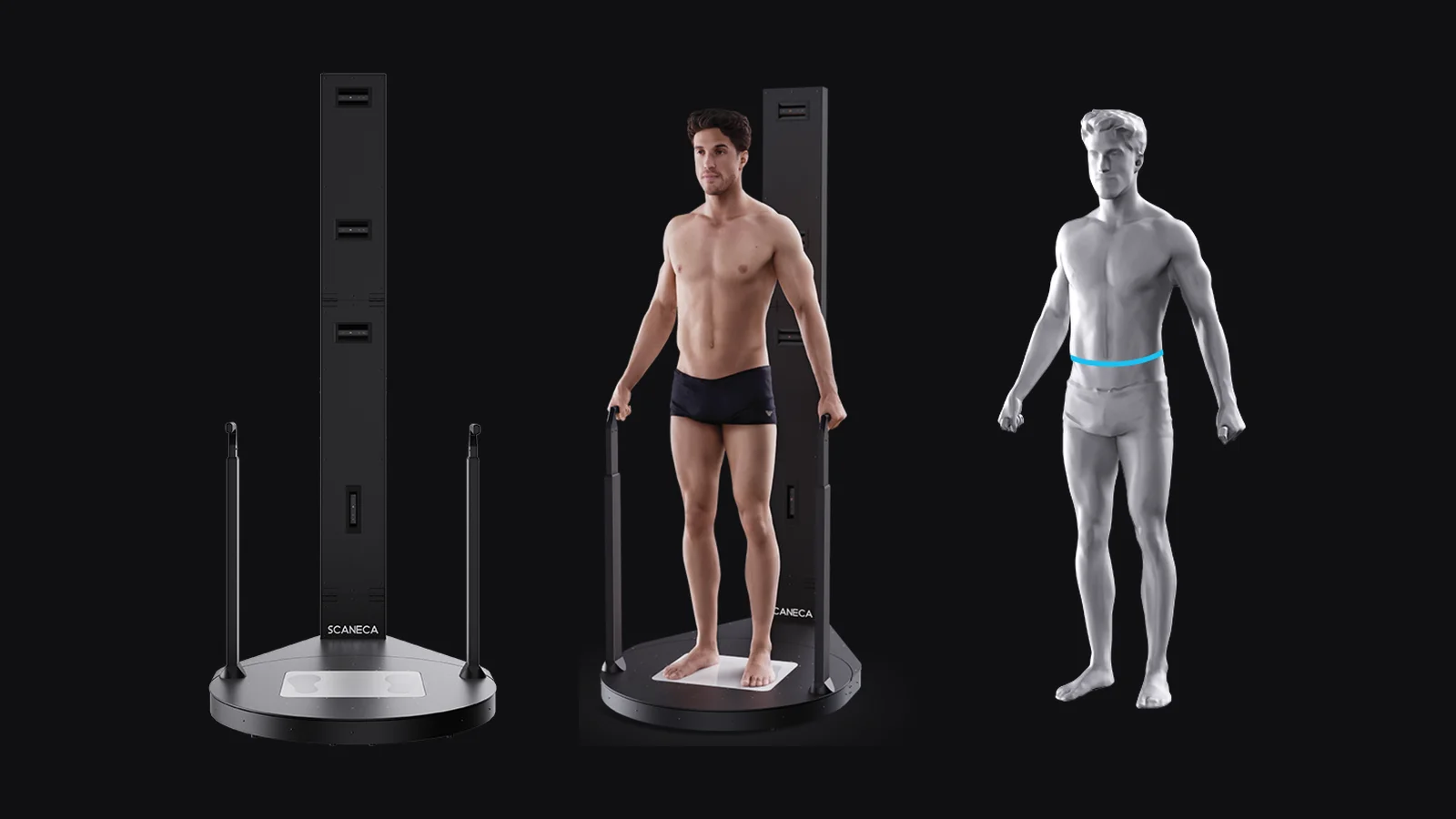
Scaneca GmbH (scaneca.de) develops mobile body scanners that create a detailed virtual copy
of the body in a single measurement process, perform a posture analysis, determine the most important
health-related parameters, and measure body circumferences.
The innovation lies in the combination of mobility, accuracy, and automated 3D model generation — a classic
example of eligible hardware development in the sense of the R&D criteria.
Despite this depth of innovation, Scaneca didn't apply for public funding for the project for years. Why — and what
changed — is what this real-world example shows.
The starting point: known for years, never applied
Scaneca had known about the Forschungszulage for a long time. They still never applied. The reason was both time and
the fear of bureaucracy: someone on the team would have had to dive deep into the topic. So it kept getting
postponed, year after year.
The idea of hiring a consultancy didn't help at first either. The worry: even with an agency, a pile of work ends up
on your desk anyway — and once you start, you're stuck in a process you never wanted. Scaneca never actively
searched for a consultancy.
The biggest hurdle wasn't the application itself — it was the uncertainty about their own workload. How many
documents would need to be gathered? How much "homework" would land on the team? Is everything even documented —
say, employee vacation from four years ago?
“
We knew the Forschungszulage existed, and we kept putting it off for years. We were aware that someone would
really have to dig into it, and we didn't have the time. The biggest problem was the worry that you just end up
wasting time on it. How many documents do I still have to gather, how much homework do I have?
Nikolay Leons
Co-Founder Scaneca
The turning point: a conversation at a trade fair
The contact didn't come through a Google search but at a trade fair booth. Erich from Zeitmaker approached the team
proactively, and two things made the difference:
A promise that addressed the actual concern: Erich organizes the entire process so the team has to invest
minimal time. The very uncertainty that had blocked them for years was off the table.
A conversation at eye level: both sides are technical people. Instead of a sales show, it was a technical
conversation about the product.
“
Erich came up to us at the trade fair and said: I understand you, I know how it is for you. I organize
everything so that you have to invest as little time as possible. That spoke to me. And then his technical
nature — I'm a technical person myself. At a trade fair you talk to sales people all day, so you're glad to talk
to a technical person for a change.
Nikolay Leons
Co-Founder Scaneca
The result: 280,000€ in Forschungszulage
Scaneca tried the collaboration with a single project: the development of the body scanner. The consequence after
the first run: Scaneca now gets the scanner development funded for the following years as well.
In total, Scaneca secured 280,000€ in Forschungszulage for the development of its 3D body scanners.
What this example means for you
The pattern we saw at Scaneca shows up at many tech companies and SMEs:
"We know the Forschungszulage exists, but we don't have the time." That's exactly what a setup is for where
the consultancy does the work instead of just advising.
"We don't know how much effort will land on us." This uncertainty is almost always bigger than the actual
effort. At Scaneca, it was the strongest obstacle.
"Is our development even eligible?" Hardware development with real technical risk — like a mobile 3D scanner
— is a textbook example of eligible R&D. That applies to MedTech just as much as to
mechanical engineering or
software.
Claiming retroactively pays off: the Forschungszulage can be claimed
up to four years retroactively. Projects
that have long been running are not lost.
The first step
Want to know whether your development is eligible and what's realistically possible? How Forschungszulage consulting works through a case like this is described here.
The development work on the mobile body scanner — primarily personnel costs of the developers for the R&D activity.
The process is organized so the team only provides input at specific points: describing the project in a call, giving access to existing documents, reviewing the application.
If you're working on something technically new or risky (new hardware, new algorithms, new processes), the odds are good. You get an assessment in the initial call — before any effort arises.
No. The Forschungszulage can be claimed for ongoing, planned, and — up to four years retroactively — even past projects.
At zeitmaker.com, the fee is 100% success-based. In the event of a final rejection, you incur no costs at all.
We measure how this website is used anonymously and without cookies. With your consent we additionally use analytics and marketing cookies (PostHog, Google) to recognise returning visits and measure advertising.