





Law & Tax
Companies in Difficulty & Forschungszulage: Rules
What is a 'company in difficulty' under EU state aid law? How it affects your Forschungszulage eligibility and what you can do about it.
May 5, 2026 · Erich Lehmann
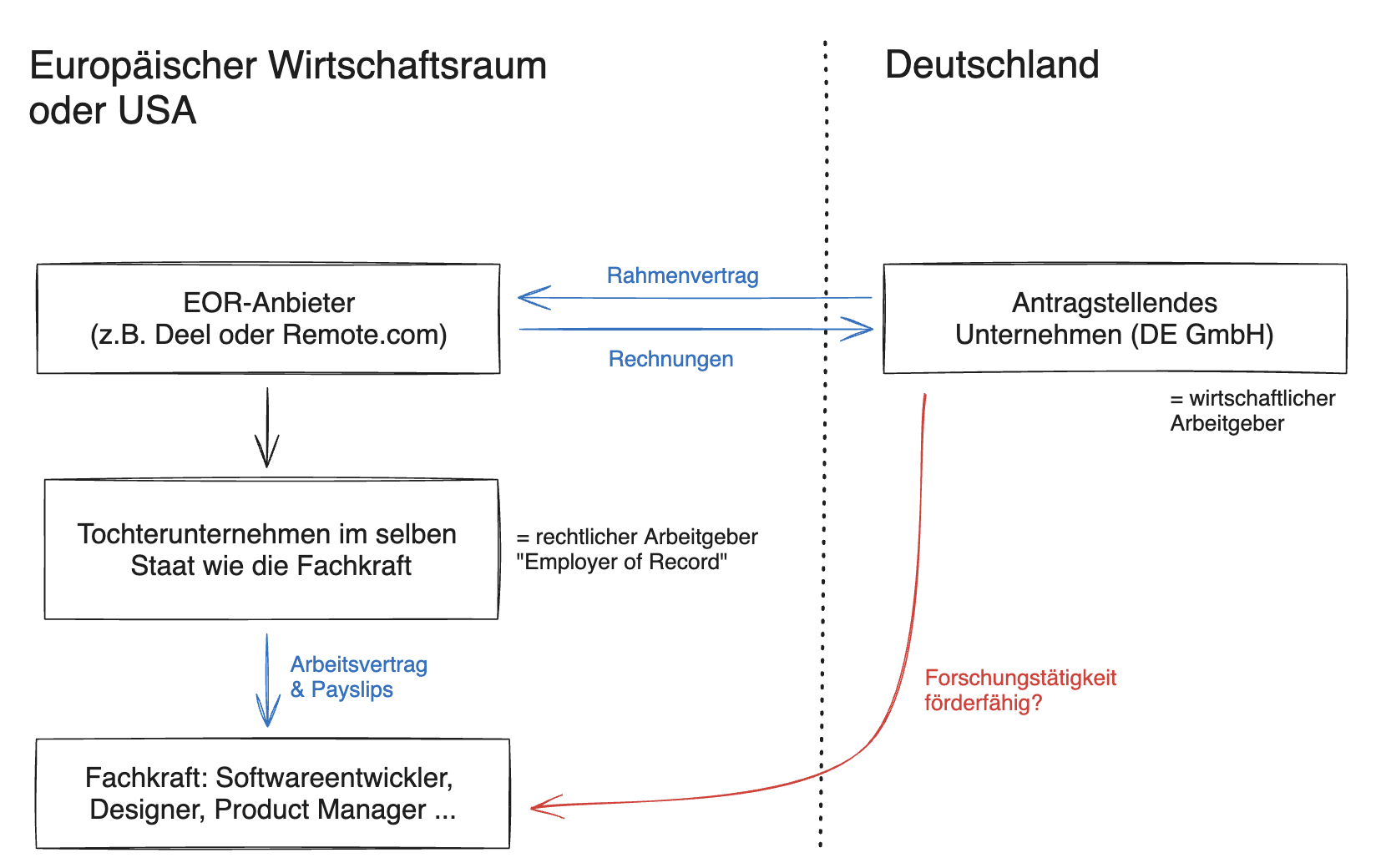
A central question is the extent to which personnel costs for employees working abroad are eligible under the Forschungszulage (FZulG), particularly when modern employment models such as the use of an Employer of Record (EOR) are used.
According to § 3 para. 1 and 2 FZulG, eligible expenditures in the context of in-house research and development (FuE) include in particular wages subject to payroll tax as well as the employer's contributions for future security of its employees (§ 3 no. 62 EStG), insofar as these relate to the share of eligible wages.
The decisive criteria here are:
To simplify the process of hiring abroad and to ensure compliance with local legal and tax regulations, many German companies use specialised service providers (so-called Employer of Record – EOR). These act legally as the employer abroad, conclude the employment contract with the employee, pay the salary and remit local taxes and contributions, while the employee effectively works for the German company and is subject to its instructions.
This arrangement leads, under a strict interpretation of the FZulG, to problems with the eligibility of personnel costs:
Under this strict analysis, salary payments for employees employed abroad via an EOR would not be recognised as the German company's own wage expense, even if the German company reimburses the costs to the EOR via a services agreement.
The following points support this alternative view:
Under this economic analysis, the expenditures for an employee employed abroad via an EOR could qualify as eligible wages, since the German company economically bears the wages and the attribution to an eligible state (via the EOR subsidiary) is established.
Regardless of the form of employment, the following applies: FuE activities are generally carried out by persons who are qualified to perform the necessary FuE work. A particular level of formal qualification is not required.⁵ Qualification is usually uncontested as long as the person actually carries out the FuE tasks.
The eligibility of personnel costs for employees employed abroad via an EOR under the Forschungszulage is legally complex and has not been conclusively resolved.
Because the assessment depends heavily on the individual case and on how the contract is structured, this point belongs before the application, not after it. Have your tax advisor review the EOR contract before the application. Forschungszulage consulting prepares the groundwork for this: which people work on the project and with how many hours.
Companies using EOR models that wish to apply for the Forschungszulage should:
It remains to be seen how practice and potentially case law will develop in relation to this constellation.
Footnotes:
¹ Cf. BMF letter of 7 February 2023, para. 76
² Cf. BMF letter of 7 February 2023, para. 92 (with reference to § 38 para. 1 sentence 2 EStG)
³ Cf. BMF letter of 7 February 2023, para. 90
⁴ Cf. BMF letter of 7 February 2023, para. 103
Drop us a line about what's on your mind — we'll get back to you personally and without obligation.
What is a 'company in difficulty' under EU state aid law? How it affects your Forschungszulage eligibility and what you can do about it.
Forschungszulage documentation: timesheets, payroll evidence, contract research & GoBD-compliant filing – how to document traceably for the tax office and audits.
You can apply for the Forschungszulage retroactively—up to 4 years. Learn how the process works, the best strategy, and what to watch out for.
Legal entitlement, retroactive claims, payout without profit: 8 benefits of the Forschungszulage, each with its FZulG section and figures from the 2026 evaluation report.
Cookies and analytics
We measure how this website is used anonymously and without cookies. With your consent we additionally use analytics and marketing cookies (PostHog, Google) to recognise returning visits and measure advertising.