





Consulting
Forschungszulage Consulting: The Process in 4 Calls
The Forschungszulage consulting process: the timeline from first call to the tax office assessment, all 4 calls in detail, and who supplies which documents.
Jan 30, 2026 · Erich Lehmann
If you use the Forschungszulage, it is not just about "submitting an application". In practice, two things determine success, funding amount, and later security in a potential tax audit:
I am Erich Lehmann (zeitmaker.com) – and this post aims to give you a clear, concise overview of the most important figures, rates, and patterns, so you can make better decisions.
The BSFZ updates its figures quarterly. Current status from 16.09.2020 through 30.06.2026: 26,042 applicant companies and 63,718 projects applied for. The trend points clearly upward: 16,723 projects were submitted in 2025, roughly twice as many as in 2022.
My take: If you are still hesitating, you should know that a standard instrument is emerging here. The more applications the BSFZ processes, the clearer its expectations around reasoning and delineation become – and the less a weak application is forgiven.
Source: bescheinigung-forschungszulage.de, data as of 30.06.2026, retrieved 26 August 2026
The BSFZ also estimates how much Forschungszulage results from the certified projects of a given submission year. For 2025 that is roughly 3.16 billion €, almost three times the figure for 2022 (1.12 billion €).
Source: bescheinigung-forschungszulage.de, data as of 30.06.2026, retrieved 26 August 2026
Rejections are not the exception for the Forschungszulage. According to a BMBF document (24.06.2024), the success rate (per project, BSFZ) averages 74.55% – meaning roughly 3 out of 4 applications are approved.
What does that mean in practice? In 2024 (through May), the success rate is 71.11% (BSFZ). And that is where it gets interesting: with professional support, the success rate in practice is 95 % (corresponding to a 5 % rejection rate).
Source: BMBF document dated 24.06.2024
A look at the industries shows: the Forschungszulage is far from being "classical industry" only. What is counted here are applicant companies, not individual projects. My take: This is exactly where you can see why I deliberately speak of innovation in my wording: many eligible projects are product, process, or software innovations – not "lab research".
Source: bescheinigung-forschungszulage.de, period 2020–2025, retrieved 26 August 2026
No. The statistics show broad usage across all size categories: 33% of applicant companies are micro enterprises and 31% small enterprises, while medium-sized companies account for 22% and large enterprises for 13%.
So there is no "only corporations" or "only startups". The core insight is: what matters is not size, but sound R&D reasoning (novelty/uncertainty, systematic approach) plus correct cost logic.
The same holds for company age: among the 2025 applicants, 34.9% had been founded no more than ten years before submission, 22.6% between ten and twenty years, and 42.4% had existed for more than twenty years. Young tech companies and the established Mittelstand use the Forschungszulage to roughly the same degree.
Source: bescheinigung-forschungszulage.de, period 2020–2025, retrieved 26 August 2026
Interpretation: The distribution roughly follows economic and industrial strength – and at the same time shows: the Forschungszulage is relevant nationwide.
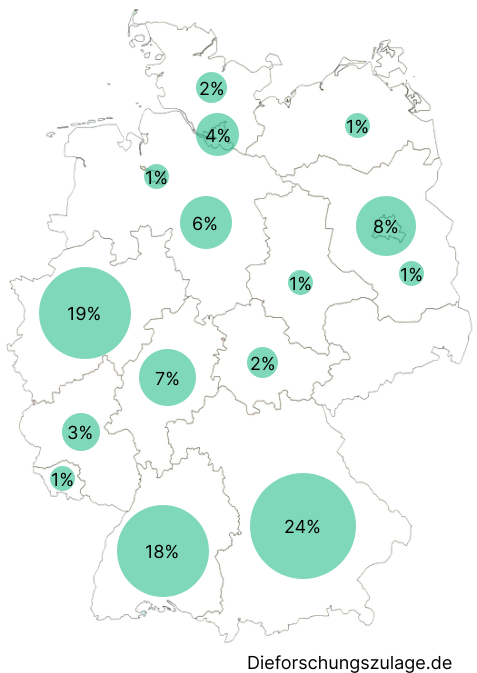
Source: bescheinigung-forschungszulage.de, period 2020–2025, retrieved 26 August 2026
I am frequently asked: "Do you really need a consultant?" My answer is pragmatic: if you want to save time, reduce risk, and optimize your funding amount – yes. Because the biggest levers are rarely in the "form", but in cost logic and project justification. Whether a DIY application is realistic in your case is covered in apply for the Forschungszulage yourself or use consulting?
€400k average funding
With us, companies often receive more money because we know which costs can be eligible and make sure none are overlooked.
more funding through us
Instead of 4 weeks, just 4 calls
We handle the writing. You only contribute your expertise in a few calls.
calls to submission
Traceably documented
While the average is around 75%, we achieve 95 % thanks to our complete, traceable documentation.
success rate
Trusted experience
We have already guided numerous companies successfully to the Forschungszulage.
Forschungszulage secured • 100+ customers
Instead of weeks of self-directed work, many teams get there with us in 4 calls:
If you want to understand the process, start here: zeitmaker.com.
For official information and procedures, the BSFZ is particularly relevant. If you want to start the process directly, the Bescheinigung platform is central: bescheinigung-forschungszulage.de.
The Forschungszulage is an excellent option for claiming innovation expenses as a tax benefit. At the same time, the statistics show: rejections are common. Those who cleanly hit the BSFZ logic, clearly delineate projects, and correctly derive costs will significantly improve their chances – and additionally protect themselves for a potential future audit.
The most important metric is the success rate: 74.55% on average (BSFZ), 71.11% in 2024 (through May). This shows: success is not "standard" – it depends heavily on the quality of reasoning, delineation, and documentation. In practice, the success rate at zeitmaker.com is 95 %.
From its introduction on 16.09.2020 through 30.06.2026, 26,042 companies have applied for a total of 63,718 projects at the BSFZ. Usage is growing sharply: 8,198 projects in 2022 versus 16,723 in 2025. The projects submitted and certified in 2025 translate into an estimated Forschungszulage claim of roughly 3.16 billion €.
Most often it fails due to (1) a too-weak justification of novelty & uncertainty, (2) a missing systematic approach (goals, hypotheses, iterations, tests) in the description, and (3) an unclear delineation between routine work and R&D.
IT services are #1 with 32% (4,953 applicant companies), mechanical engineering #2 with 20% (3,069). Together that is 52% of the top 10 – a clear signal that software and process innovations are a central driver of the Forschungszulage in practice (not just "lab research").
It is used across all size categories: 33% of applicant companies are micro enterprises, 31% small enterprises, 22% medium-sized companies, and 13% large enterprises. So there is no "only corporations" or "only startups". The core insight is: what matters is not size, but sound R&D reasoning (novelty/uncertainty, systematic approach) plus correct cost logic.
Very concentrated: Bavaria (24%), North Rhine-Westphalia (19%), and Baden-Württemberg (18%) account for 61% combined. The distribution roughly follows economic and industrial strength, but also shows nationwide relevance (beyond the top 3).
In short: higher probability of success and better funding logic. Our practical figures: a 95 % success rate, an average of 400.000 € in funding, and on average 25% higher funding (typically +75.000 € more), because we work out delineation and storyline the way the BSFZ reviewers assess them, and overlook no cost potential.
For the official process, the Bescheinigung platform is central: bescheinigung-forschungszulage.de. For expert support, you will find information and contact at zeitmaker.com.
Drop us a line about what's on your mind — we'll get back to you personally and without obligation.
The Forschungszulage consulting process: the timeline from first call to the tax office assessment, all 4 calls in detail, and who supplies which documents.
Received a BSFZ rejection? You have one month to object, you can file informally and submit the reasoning later. Structure, costs and the most common grounds.
When does the Forschungszulage get paid out? Expect 6–9 months. Learn how the tax offset works and why startups especially benefit.
Loans, equity, grants or Forschungszulage? Compare all funding options for innovative SMEs in Germany. Find what fits your company best.