





Funding Comparison
Forschungszulage in Corporate Groups: Rules & Tips
Forschungszulage for affiliated companies: how to delineate projects, manage funding caps and handle contract research within your group.
Feb 21, 2026 · Erich Lehmann
Many companies invest in innovation — but financing is often the bottleneck: prototypes, tests, iterations, engineering capacity, and documentation all cost time and money. The KiteKraft use case makes it tangible how the Forschungszulage can help implement innovation projects systematically and with better financial predictability.
Particularly with demanding technologies (such as new energy systems), significant effort arises before a product can be scaled. This is precisely where the Forschungszulage comes in: it rewards innovation work that is methodically planned and technically justified.
KiteKraft pursues a clear vision: to accelerate the transition to clean energy — with a technology that has the potential to fundamentally transform wind energy. Instead of conventional towers, the company develops flying wind turbines.
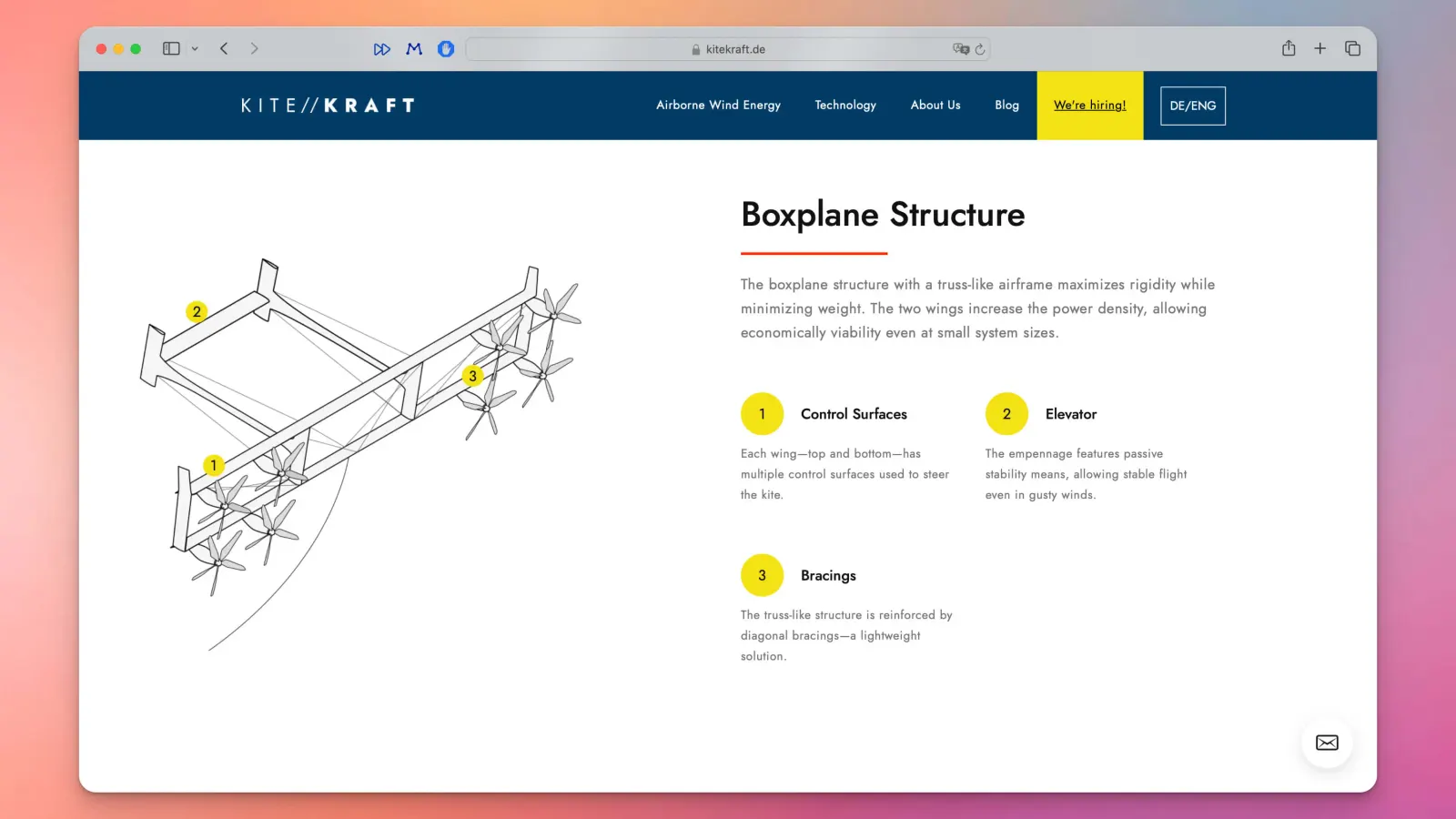
At the core are designs engineered for high power density at low weight. The following technical approaches are combined, among others:
KiteKraft describes its designs as potentially up to 10 times more efficient than conventional wind turbines — a strong example of how innovation can produce not just incremental but structurally new solutions.
As part of the use case, KiteKraft was able to secure 169,250€ through the Forschungszulage. This funding is particularly relevant because it is:
The crucial point: the Forschungszulage is not just "money", but an instrument to document innovation more systematically, delineate it cleanly, and make it eligible for funding.
The Forschungszulage is for many companies the "low-barrier" funding option with high strategic impact — especially when:
It is therefore ideally suited to companies like KiteKraft, where the innovation lies not just in the product but also in architecture, controls, material concept, and system integration.
For the Forschungszulage to deliver its full benefit, a clean process is essential: correct project delineation, clear technical description, comprehensible novelty/uncertainty, and appropriate documentation.
zeitmaker.com provides support from the first project check to the BSFZ certificate and then prepares the groundwork for the tax advisor. The approach delivers above all one thing for companies: less internal effort with higher certainty of success and planning.
Concrete advantages (with figures) at zeitmaker.com:
For the Forschungszulage, official information is particularly important — both regarding the legal basis and the process:
The KiteKraft use case stands for ambitious technology development with real impact. At the same time it demonstrates very practically: the Forschungszulage can be a decisive lever for strengthening innovation work financially — without companies having to navigate opaque funding competitions.
If you are developing innovations (e.g. new products, processes, software, or technical systems), a structured look at the Forschungszulage is almost always worthwhile, either on your own using the guides or through Forschungszulage consulting.
The Forschungszulage is a government subsidy that companies can receive for eligible innovation activities — as a tax benefit on certain project costs.
For projects that are technically demanding and involve genuine uncertainties — e.g. development of new systems, prototypes, technical software development, new materials, or intelligent controls.
No. The Forschungszulage is not limited to start-ups. It can in principle be used by many companies, provided the requirements are met.
No. What matters is the eligible innovation work (e.g. development, tests, iterations) — not a market-ready end product.
At the BSFZ (certification body) as well as at official federal bodies such as the Federal Ministry of Finance and zoll.de.
The fastest way is through a structured project check. At zeitmaker.com you can get information and take the next step towards assessment and application.
Drop us a line about what's on your mind — we'll get back to you personally and without obligation.
Forschungszulage for affiliated companies: how to delineate projects, manage funding caps and handle contract research within your group.
What does 'systematic' (planmäßig) mean for the Forschungszulage? Misconceptions, practical examples and a checklist for your BSFZ application.
What does 'uncertainty' (technical risk) mean for the Forschungszulage? Practical examples and how to describe it for a BSFZ-ready application.
What does Neuartig (novelty) mean for the Forschungszulage? Practical examples for software, AI and new contexts — plus how to demonstrate novelty for BSFZ.