





Practice & Tips
Forschungszulage Timesheet Templates (Free Download)
Free Forschungszulage timesheet templates (PDF, Excel, Word). Proper time tracking is essential for eligible R&D personnel costs. Download now.
Feb 24, 2026 · Erich Lehmann
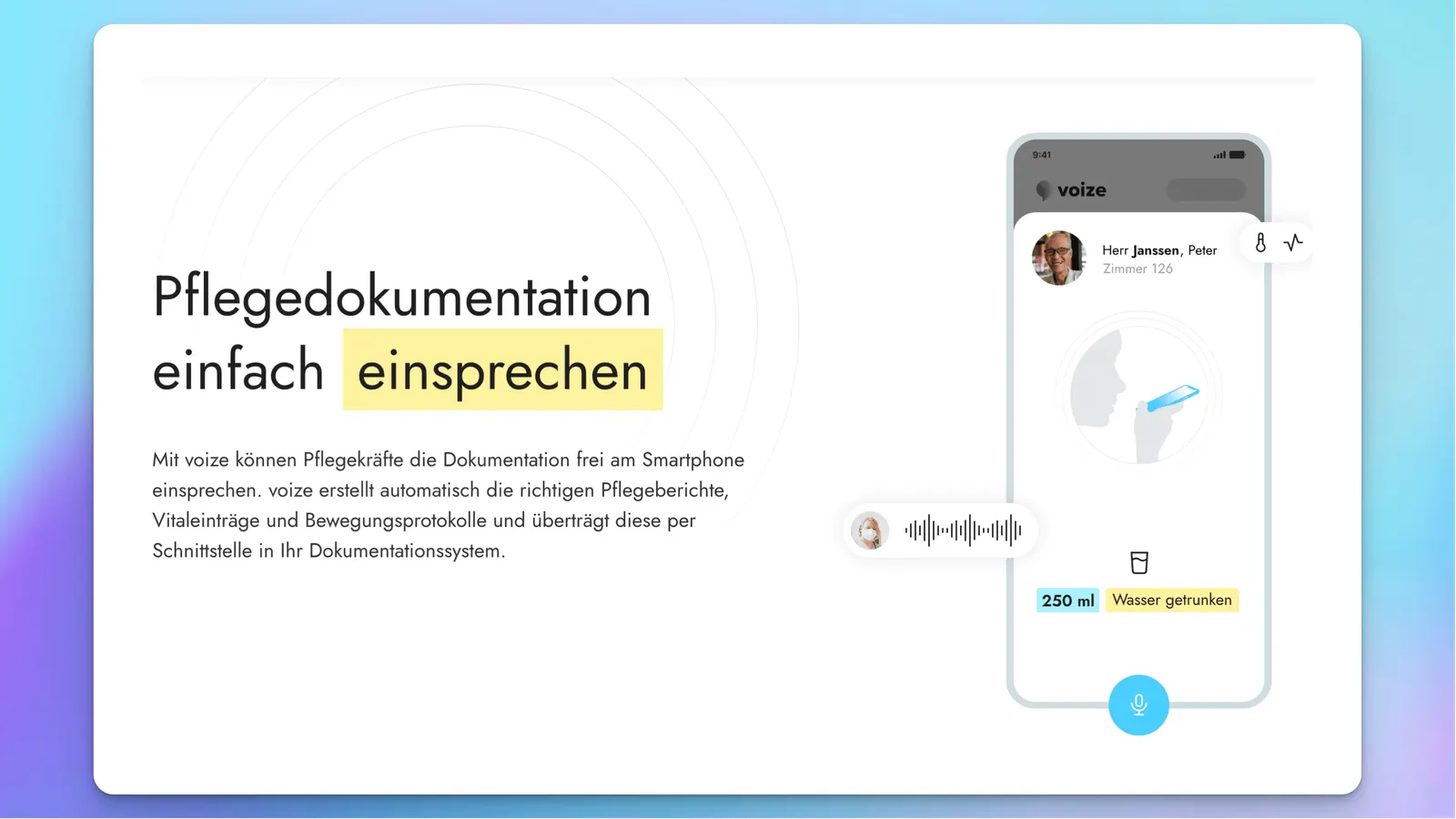
In care, documentation determines quality, safety and traceability – yet it is also one of the biggest time drains in everyday practice. Anyone who innovates here is solving a real scaling problem: less friction, better data, better processes.
This is exactly the point where funding becomes strategically relevant: because until an AI solution works reliably in daily practice, it takes iterations, tests, integration and clean delineation – precisely the kind of innovation work that often competes for budget and capacity. This is where Forschungszulage can help to set up innovation projects systematically and make them financially more predictable – for example through prototype work and validation: when prototypes count as R&D.
voize positions itself as AI-powered care documentation, developed close to real-world practice with a focus on speed and usability in everyday use.
The core of the use case: voice-based documentation is implemented in a way that does not merely enable "dictation" but makes entries structured and compatible with existing systems.
Key features (practical and innovation-driven):
The value proposition is clear: noticeable time savings and better documentation quality – exactly the combination that genuinely advances care processes.
314,825€ in funding was secured for voize. This is especially interesting because it shows: innovation in regulated, complex environments (such as care and healthcare) is eligible for funding when it is technically well-founded, planned and verifiably implemented.
And this is exactly where the bridge to Forschungszulage matters: as a tax-based incentive, it rewards innovation that proceeds methodically and addresses genuine technical uncertainties – for example in AI-powered processing, system integration, quality assurance and validation. What counts here is not "marketing novelty" but traceable technical work, for example along criteria such as systematic approach: What does "systematic" mean?
Many digital teams experience this similarly: the biggest effort arises before the scalable roll-out – in iterations, stabilisation, tests and integration.
Forschungszulage is particularly well suited when:
In short: when innovation is actually "built" – not just conceived.
For Forschungszulage to have its full effect, a clean process is required: project delineation, clear technical argumentation, traceable novelty/uncertainty and appropriate documentation. Entry point and process overview: application process.
zeitmaker.com supports companies from the first project check to the BSFZ certificate and then prepares the groundwork for the tax advisor, with a focus on efficiency and implementation.
Concrete advantages (with figures) at zeitmaker.com:
Starting point & overview: zeitmaker.com
voize is an exemplary case of an especially relevant kind of innovation: AI that saves time and improves quality in real workflows. At the same time, the use case shows: with the right structure, such projects can be made eligible for funding – and Forschungszulage is often the most predictable lever for this, because it does not let innovation "win" by chance, but rewards it methodically.
If you are developing software, processes or AI solutions: a structured check for Forschungszulage is almost always worthwhile. If you would rather not do it yourself, Forschungszulage consulting takes it on.
Often yes – if it involves a technically demanding innovation project and genuine technical uncertainties are being solved (e.g. processing, quality assurance, integration, validation).
No. What matters is the innovation work (development, tests, iterations, technical validation) – not the finished end product.
Personnel costs for work on the innovation project are often particularly relevant (e.g. development/engineering). Which costs can be included in detail depends on the specific setup.
No. What matters is a clean technical description and traceable project logic (objective, uncertainties, approach, results).
At the BSFZ, at the Federal Ministry of Finance, and at zoll.de.
With a structured project check to assess effort and eligibility early on. Start at zeitmaker.com.
Drop us a line about what's on your mind — we'll get back to you personally and without obligation.
Free Forschungszulage timesheet templates (PDF, Excel, Word). Proper time tracking is essential for eligible R&D personnel costs. Download now.
Forschungszulage for affiliated companies: how to delineate projects, manage funding caps and handle contract research within your group.
KiteKraft secured 169,250€ in Forschungszulage for flying wind power systems. How tax-based R&D funding finances clean energy innovation.
What does 'systematic' (planmäßig) mean for the Forschungszulage? Misconceptions, practical examples and a checklist for your BSFZ application.